The spirit of Santerí­a dances on: Courtesy of and by Tony Montague

The spirit of Santerí­a dances on
by Tony Montague

http://www.straight.com/article-115429/the-spirit-of-santeria-dances-on

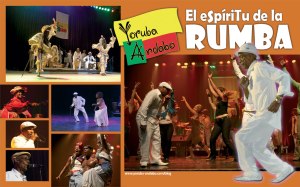
When members of Yoruba Andabo perform the rumba gua ­guanc, you can expect feathers to fly. The ritualistic Afro-Cuban dance represents the courtship of a rooster and a hen. To intricate drum rhythms and call-and-response chants, the male performer attempts to catch his partner off guard touching her crotch with the flick of a handkerchief or thrusting his limbs and pelvis at her provocatively while the female symbolically protects herself with hand or skirt.
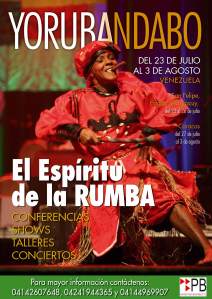
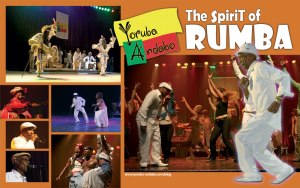
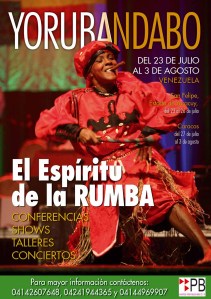
Yoruba Andabo Promocion Venezuela verano 2015posterWebEnglish (2)
“The guaguanc is the most popular form of rumba, which was created in the ports of Matanzas and Havana, where most of us come from,” says Matí­as Geovani del Pino Rodrí­guez, singer, director, and cofounder of the 15-piece Yoruba Andabo ensemble. “It has always been an important part of what we do. The company started out in 1961 as Guaguanc Marí­timo Portuario a group of dockworkers who got together to perform at a labour festival.

“But our interest was not only in rumba,” continues Rodrí­guez. “We wanted to celebrate all aspects of our Afro-Cuban heritage, which is rich and complex. When the slaves were shipped across the Atlantic, all they took with them was their music, their dance, and their religious beliefs. They maintained these traditions through centuries of repression by concealing their activities, often in ingenious ways. Since the [1959 Cuban] revolution, Afro-Cuban culture has come out in the open, and is now experiencing a major revival.”
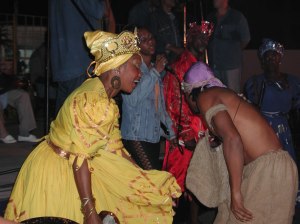
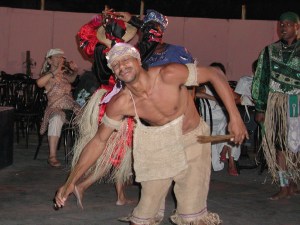
YorubaAndabo1MedYorubaAndabo2Med

At the heart of the mesmerizing spectacle that Yoruba Andabo  presents is the dance and music of Santerí­a, a religion rooted in West Africa, and among the Yoruba people of Nigeria in particular. Its initiates venerate orishas (or santos), spirits similar to the gods and goddesses of ancient Greece. In Cuba, the slaves fused these orishas with Catholic saints, in whose name and image they could be worshipped. Sometimes genders were crossed: Chang & the orisha of manhood, fire, thunder, and lightning was equated with St. Barbara, probably because, like hers, his emblematic colours are red and white.

“All of the orishas have their own colour, dress, and symbols as well as their own ritual dance, chant, and toqué [rhythm],” Rodrí­guez explains. “We present the most important deities: Elegguá, Oggún, Ochún, Yemayá, Babalú, Chang, and Obbatalá. The dancers perform solo, and express the particular qualities of each orisha. Their movements are based on tradition, though these are not precisely choreographed the dancer follows the rhythms played by the drummers, who in turn follow the chant of the leader and chorus.”

The company Yoruba Andabo has a long-standing link with the arts scene in Canada. In 1993, it earned a Juno for contributing to jazz saxophonist Jane Bunnett’s Spirits of Havana.

“We are travelling all over the world, and keeping our Afro-Cuban arts and culture alive,” says Rodrí­guez. “This is why we are called Yoruba Andabo, because in the Carabalí­ language [of Nigeria], andabo means ‘a friend or admirer,’ and we are all friends and loyal followers of the Yoruban religion. It sustains us, just as it sustained our ancestors.”

http://www.cubamusic.com/Store/Album/010897/yoruba-andabo/el-espiritu-de-la-rumba
Hello World, the blog of Yoruba Andabo begins!

cropped-Yoruba-Andabo-promotion-Venezuela-summer-2015.jpg posterWebEspanol (2)DESIGN-Logo-Yoruba-Andabo

Yoruba Andabo is a Cuban band and a talented company of 16 singers, percussionists and dancers, performing sacred W Original African music is preserved as it has-been interpreted locally, after it HAD Been Brought there by slaves in the late 16th century. The ensemble Takes African ITS name from two words loosely translated as “the friends and followers of the Yoruba lands and culture.”

The Company HAD ITS genesis in the docks of the port of Havana in 1961. When workers trade union Gathered at parties and art istic events. This Brought about the emergence of the Maritime Port Guaguancó ensemble in 1985 Began That ITS professional work under the name Yoruba Andabo. From That moment on, the music group has-been performing at different activities organized by the Cuban Union of Writers and Artists (UNEAC). Yoruba Andabo have worked With the Cuban record label EGREM, at the initiative of the composer and singer Pablo Milanes, and shared the stage With folk singer Merceditas Valdes.

The Company is Currently Composed of 16 artists Including singers, percussionists and
dancers. Yoruba Andabo cultivars distinct musical genres from the African
roots of Cuban culture That includes Congo, Yoruba, Abakuá cycles and the so called
complex call of the Rumba With its traditional rhythms, Especially the Yambú, Guaguancó and Columbia rhythms. Also there are elements of fusion crossover With other musical genres, just thus creating contemporary voices and sounds.

The skilled artists from the Company are professional and accredited instructors and offer master classes, lectures and workshops on singing, dance and percussion. They are motivated by a wide ranging musical repertoire interwoven with unique and exceptional choreographies Which grows year after year in a profound and meticulous way.

LogoYorubaAndabo_letrasHorizontal (2)cropped-cropped-posterwebenglish-22.jpg

Yoruba Andabo’s art has-been appreciated by audiences at many public places and Well Known theaters around the world. From Canada, Brazil, the Caribbean, Colombia, Spain, Mexico, Geneva, Paris, and London, Yoruba Andabo have even sold out and Performed at the famed Carnegie Hall in New York City. ‘

[Embed] http: // http: //youtu.be/aFsWCwg0AnU [/ embed]

The Spirit of Rumba – Buy Now!

LogoYorubaAndabo_letrasHorizontal (2)DESIGN-Logo-Yoruba-Andabo

Yoruba Andabo is a Cuban band and a company of 16 singers talented percussionists and dancers performing music of West Africa sacred original preserved as interpreted locally, after being taken there by slaves in the late 16th century group takes its name from two African words loosely translated as “the friends and followers of Yoruba land and culture.”

Resume
The Company has its genesis in the docks of Havana in 1961, when a group of workers gathered at parties and union artistic events. They gave rise to Guaguancó Maritime Port, whole, in 1985, he began a professional career with the name of Yoruba Andabo.
From that moment, he offered his art in various activities of the Union of Writers and Artists of Cuba (UNEAC) He worked with the record label EGREM, initiated by the composer and singer Pablo Milanes, and shared the stage with folk singer Merceditas Valdes.
Currently, the company integrated 16 artists, singers, drummers and dancers. The cast grown dissimilar genres that make up the African roots of Cuban culture and include losciclos Congo, Yoruba, Abakuá and called the rumba, with its traditional rhythms, especially yambú, guaguancó and Columbia, but also They include elements of fusion with other musical genres, creating contemporary sounds and voices.
Several Andabo Yoruba artists unfold as teachers and teach master classes and workshops in singing, dancing and drumming. Motivates them wide repertoire interwoven with unique choreographies that grows each year of deep and thorough manner.

The Spirit of Rumba – Buy Now
discography Yoruba Andabo exceeds twenty titles, many of which have won awards nationally and internationally.
He conquered a Juno Award, the Canadian equivalent of the American Grammy Award nominations from the Academy of Music Spain and a shared and two nominations for the Latin Grammy.
Andabo Yoruba art has been appreciated by audiences of important places and scenes from Canada, Brazil, the Caribbean, Colombia, Spain, Mexico, Geneva, Paris, London and the famed Carnegie Hall in New York.