La UNEAC en sus 55 años de historia › Cultura › Granma – Órgano oficial del PCC

http://www.granma.cu/cultura/2016-08-29/la-uneac-en-sus-55-anos-de-historia-29-08-2016-15-08-50

El hilo conductor de los festejos por el aniversario 55 de la Unión de Escritores y Artistas de Cuba (UNEAC) es un verso de quien fuera su primer presidente, el poeta Nicolás Guillén (1902-1989): “Así hemos de ir andando”.

Las celebraciones comenzaron con el año, y aun cuando el 22 de agosto, día fundacional, tuvo un cenit con una Gala en la sala García Lorca del Gran Teatro de La Habana Alicia Alonso, las actividades continuaran hasta diciembre, incluyendo un Consejo Nacional, el máximo órgano de dirección, convocado para septiembre.

Para homenajear a Nicolás Guillén, presidente de la UNEAC desde su fundación hasta su muerte en julio de 1989, se exhibió un nuevo documental, Nombre común: Nicolás, del realizador Ernesto Bosch, de la Productora de Audiovisuales Octavio Cortázar.

La Gala fue dirigida por el maestro Alberto Méndez quien utilizó versos de la extensa obra poética de Guillén como prólogo a la entrada de los artistas que participaron, entre ellos el Ballet Nacional de Cuba, el Coro Nacional, el grupo Yoruba Andabo, el Septeto Nacional, el Trío Lecuona y la soprano Milagros de los Ángeles.

How this Cuban dancer is honoring his legendary dad | New York Post

SIEMPRE CUBA!!!

Stevie Insua is one of the most popular instructors at Alvin Ailey, where he teaches Afro-Cuban dance on Friday nights to the general public. It doesn’t matter that the 40-year-old barely speaks English — as he whips his long braids and demonstrates the proper way to do a cha-cha step, you can feel the room shed its collective inhibition.

“My father was a dance teacher, so it’s in my blood,” the Havana-born Insua tells The Post in Spanish. “He had me do my first performance when I was 4 years old. I danced the rumba onstage while holding these two lit candles — without getting burned!”

His father was the legendary Felix “Pupy” Insua, who performed all over the world and who was brought to New York City by “Mambo King” Eddie Torres to teach his troupe how to dance authentic Cuban salsa. Insua now has his father’s old job, teaching traditional Afro-Cuban dance at Ailey Extension, which provides classes to the entire New York City community.

Insua was born in 1976 in the artist and worker community Cayo Hueso in Havana. His mother was a flamenco dancer and singer, and for a while she performed with Insua’s father, before Stevie came along.

via How this Cuban dancer is honoring his legendary dad | New York Post

Nilda Guerra on keeping a dance company going in Cuba and being inspired by Carlos Acosta | Arts | Going Out | London Evening Standard

http://www.standard.co.uk/goingout/arts/nilda-guerra-on-keeping-a-dance-company-going-in-cuba-and-being-inspired-by-carlos-acosta-a3304761.html

Yoruba Andabo: Congratulates the first winner of the DVD contest!

Dear Verónica,

Congratulations on being the first winner of the DVD contest. Kindest regards from artists and direction of Yoruba Andabo.

Cordially,

José Luis Lobato

Manager

Company Yoruba Andabo

Buenas tardes Verónica,

La felicitamos por ser la primera ganadora del Concurso. Reciba un cordial saludo de parte de los artistas y la dirección de Yoruba Andabo.


Cordialmente,

José Luis Lobato

Manager

Compañía Yoruba Andabo

A Short Bio on our Winner:

Veronica is an Acupuncturist, practising in Greater Los Angeles. A healer, health enthusiast, and animal lover! You’ll find her creative side at @nickyv_ace. Instagram accounts:@thehealingwell @nickyv_ace. “Writer, Artist, Poet” Facebook:nickyv.ace.7@facebook.com Love classic, cool & vintage Original photos & artwork will be watermarked.

 Nurture By Nature Acupuncture

Owner and Licensed Acupuncturist · Los Angeles, California www.nurturebynatureacupuncture.com

https://www.facebook.com/polepixie


Old Havana or old Havana? – Havana Times.org

HAVANA TIMES — Many foreigners long to visit Old Havana and the majority of Cubans do as well. Every year, millions of tourists walk along its cobblestones, enjoying the best attractions, hotels and attractions the city has to offer. This is the Havana we find in guide books, on websites, labelled “exotic, interesting”: a place you have to go to at least once in your life. This is Old Havana, the beautiful Havana.

Founded in 1519 and baptized San Cristobal de La Habana in honor of Havana’s patron saint, the city owes its name to the chief Habaguanex who controlled the area in the years leading up to its colonization. Today, it is our capital and the most populated city in Cuba and the Caribbean islands as it has 2,125,320 inhabitants (2015).

It’s history is as old as its architecture.

via Old Havana or old Havana? – Havana Times.org

Rumba Thrives on the Streets of Cuba | Miami News, Food, Culture and Events | Miami New Times

via Rumba Thrives on the Streets of Cuba | Miami News, Food, Culture and Events | Miami New Times

07/17 | Batá and Rumba Drumming (Cuba) Concert w/Contemporary Music Project

An afternoon of Cuban style drumming from the Contemporary Music Project.  Learn more about these unique styles, and feel like you are being transported to Cuba.Batá are the most sacred drums of the Lucumí — the Yoruba people in Cuba. Their rhythms invoke the melodies and harmonies of a lost and distant world. When played with their many songs, the batá are a musical bridge to a universe where rhythms speak words and the drum is the voice of a god.Rumba drumming is the key to the Cuban soul, the voice of the street, and a celebration in song, dance, and drum. It is the newspaper, a way of spreading knowledge, a form of social resistance, and a comment on daily life. Its driving rhythms and lilting songs ring with the spirit of the island.Contemporary Music Project’s director Don Skoog is a musician, teacher, and writer who lives in Oak Park.  He gigs on drumset, Latin percussion, Marimba, and Flamenco cajon. He founded the Project in 1982, and has traveled to Cuba numerous times.

Source: 07/17 | Batá and Rumba Drumming (Cuba) Concert w/Contemporary Music Project

Yoruba Andabo is proud to announce its new director Didiel Armando Acosta Mitjans!

Didiel Mitjans Acosta was elected by Yoruba Andabo artists as the new director of the company, after the death of Master Geovani del Pino, founder director.
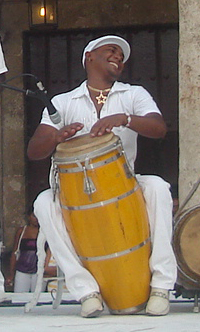
Didiel.jpg


MONTREAL, QUEBEC, CANADA, June 27, 2016 /EINPresswire.com/ — Yoruba Andabo welcomes its new director!
Percussionist and singer, Didiel Acosta Mitjans began his career at age 11 with the Cuban children’s group Pequeñas raíces de Aña. In high school he studied music theory and has been a member of the National Union of Writers and Artists of Cuba (UNEAC) since 2011.

Between 1999 and 2008 he was part of the group Los Ibeyes. He has participated as a percussionist in phonograms “The story of Chano Pozo” held in France, 2003 and in the version made by the EGREM in 2005. He performed in the show “The story of Chano Pozo” of the group Pequeñas raíces de Aña, which appeared in theaters in Havana, Venezuela, Denmark and France, and as a musician in Los Ibeyes, in important Cuban theaters such as the “America,” “ Mella, “Terry” and the “Karl Marx.”

In the middle of 2008, he joined the company Yoruba Andabo as the major solo percussionist and singer, providing synchronizing or backing vocals. At the end of 2012 he was promoted to musical director. With Yoruba Andabo, he has performed in theaters and various places national shows, at the Concert for Peace in Cubadisco Festival Drum, Tour of Cuba and Timbalaye International Festival.

In 2009, he was part of the show “Yoruba Andabo: Rumba in Havana,” which was presented at the Barbican Center (London) and in Colombia as well as in Belo Horizontes and Sao Paulo (Brazil) in 2010.
In 2011, with the release of “Yoruba Andabo, The Spirit of the Rumba,” the same year led him to French Guiana, Guadeloupe, and the company was invited to the important Festival of Bergen (Norway) and Paris, jointly playing a concert with Iranian percussionists.

In 2011, Didiel participated in the recording of the album “Yoruba Andabo, The Spirit of the Rumba,” licensed by Bis Music. By continuing the same performance standards as musical director of the band on the album “Soy de la Tierra Brava,” the famed group was recently awarded the Cubadisco 2016 Award.

From 2011 to date, Didiel Acosta Mitjans has participated in dozens of concerts of Yoruba Andabo in Venezuela, Norway, France, Austria, French Guiana, Guadeloupe and the US. He has taught percussion workshops in academic and cultural institutions in Cuba, Europe and Latin America.

Yoruba Andabo en Cuba Music – iTunes – Amazon – Spotify:

http://www.facebook.com/profile.php?id=100007448116791

Google+ Yoruba Andabo Official Page

http://plus.google.com/u/0/b/108740448345920191387/?pageId=108740448345920191387

Facebook.com/Yoruba-Andabo

Twitter.com/YorubaAndabo1

@yorubaandabo1

Instagram.com/YorubaAndaboOfficialPage

https://yorubaandabo.wordpress.com/

YouTube Channel; Yoruba Andabo Official Page

http://www.youtube.com/channel/UCY4M9G5JctIoH7GYMbNWQkA

http://www.cubamusic.com/…/yoruba…/rumba-con-amor-mini-album
http://itunes.apple.com/…/el-espiritu-de-la-ru…/id967666081

via Yoruba Andabo is proud to announce its new director Didiel Armando Acosta Mitjans!

Rhythm in Your Blood: Meet the Young Artists Keeping Cuba’s Traditional Music Alive | Pitchfork

via Rhythm in Your Blood: Meet the Young Artists Keeping Cuba’s Traditional Music Alive | Pitchfork


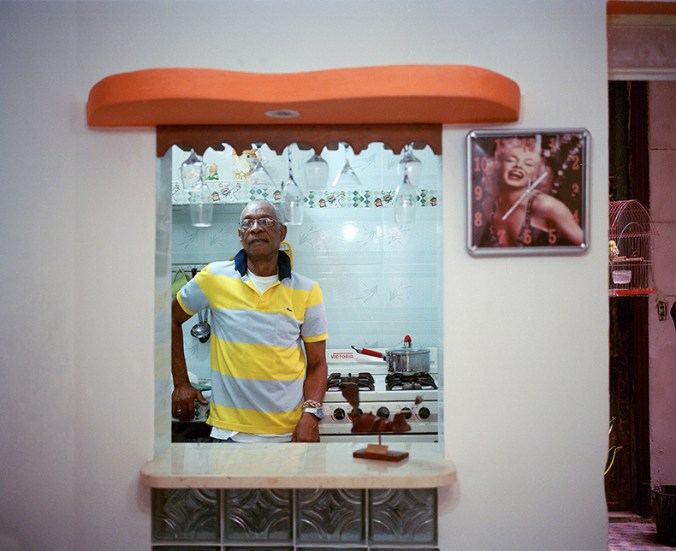
49_yoruba_kitchen790

The seed of all Cuban music can be found in rumba, a combination of textures that interlock and play out through polyrhythmic percussion, dance, and song. The distinct sound, anchored by clave sticks, a wooden cylindrical hi-hat of sorts called the catá, and a trio of conga drums of different pitches, has not only molded genres within the country but also fanned out worldwide to touch everything from jazz, to disco, to funk. To rumberos—Cuban street drummers—rumba is as all-encompassing as life itself.

“It’s an expression of Cuban style,” says Geovani del Pino, the 73-year-old director of Yoruba Andabo, the Latin Grammy-winning 15-piece band that has been fundamental in representing rumba internationally. “I don’t think that someone who calls themselves Cuban feels a conga without his feet moving.”

Although considered to be secular music, rumba retains a significant overlap with elements of Afro-Cuban religions such as Santeria, Palo, and Abukuá, born from traditions and rituals brought over by slaves on ships from Africa centuries ago. And similarly to spoken language, rumba doesn’t stand still. It evolves, reflecting moments through time as it progresses. More traditional musicians stay closer to its form and ritualistic uses, leaving younger artists to experiment, twist, and pull the rhythms.

“Yo sigo siendo un cantautor”, dice Yoyo Ibarra – CiberCuba

“Tropical” lo componen diez temas de la autoría de Yoyo Ibarra y hasta el momento están invitados los músicos Pancho Amat, Yoruba Andabo y Cándido Fabré.

via “Yo sigo siendo un cantautor”, dice Yoyo Ibarra – CiberCuba